You’ve been there before. A client asks for a real estate website. You know WordPress, you know Elementor, and you start piecing things together: one plugin for listings, another for the search, a third for lead forms, a CRM integration, a membership plugin for paid submissions, a map widget, a currency switcher. Before you know it, you’re managing nine different plugins from nine different vendors — and the site isn’t even live yet.
This is the standard approach. And on the surface, it seems reasonable. But when you add up the real cost — in money, time, and ongoing maintenance — the picture changes dramatically.
The Plugin Stack Most Developers Build (And Its Real Price Tag)
Let’s be specific. A typical real estate website built on WordPress with a generic theme might require the following plugin stack:
- Property listing management plugin — e.g. Essential Real Estate or WP Property
- Advanced search & filters plugin — often requires paid extensions
- Lead capture and inquiry forms — typically Gravity Forms, WPForms or CF7 + CRM connector
- CRM or lead management — HubSpot, Salesflare, or a standalone WordPress CRM plugin
- Map integration — Google Maps API + a dedicated property map plugin
- Membership & payment system — MemberPress, Paid Memberships Pro, or WooCommerce + add-ons
- Agent/agency profile system — custom post types + ACF or a dedicated plugin
- Multi-currency support — a dedicated currency switcher plugin
- GDPR compliance tools — Cookie Notice, Complianz, or GDPR Cookie Consent plugin
That’s nine plugins before you’ve written a single line of custom CSS. And each one carries its own cost.
The Three Layers of Hidden Cost
1. The Financial Cost
Many real estate plugins are either freemium — meaning the version you actually need costs money — or require annual license renewals. Here’s a conservative estimate of what a complete plugin stack costs per year:
| Plugin / Tool | Annual Cost (est.) | Notes |
| Listing management plugin (pro) | $79–$149/yr | Base functionality |
| Advanced search with filters | $49–$99/yr | Often sold as add-on |
| Lead forms (WPForms Pro, etc.) | $99/yr | Entry-level plan |
| CRM integration / plugin | $120–$300/yr | Even basic CRM tools |
| Membership & payments plugin | $149–$249/yr | MemberPress / PMPro |
| Map plugin (pro tier) | $39–$79/yr | Google Maps quota costs extra |
| GDPR compliance plugin | $49–$99/yr | Required in EU markets |
| Generic theme license | $59–$79/yr | Annual renewal for updates |
| TOTAL (conservative estimate) | $643–$1,073/yr | Per site, recurring |
And this is before accounting for developer time spent configuring, styling, and debugging each tool. It also assumes nothing breaks — which, inevitably, something always does.
2. The Time Cost
Time is the cost nobody puts in a spreadsheet. But it accumulates fast. Consider what happens across a typical real estate project timeline:
- Research & selection: Finding and evaluating compatible plugins — 3 to 6 hours
- Installation & initial configuration: Setting up each plugin correctly — 4 to 8 hours
- Conflict resolution: When Plugin A breaks Plugin B after an update — 2 to 10 hours (unpredictable)
- Design consistency: Making 9 different tools look like one coherent UI — 5 to 15 hours of CSS work
- Ongoing maintenance: Monitoring updates, testing after each one, fixing regressions — 1 to 3 hours/month per site
For a freelancer billing at $50–$80/hour, that initial build overhead alone represents $700–$3,000 in unbillable time. For an agency, multiply that across every client project.
And the hidden time cost that stings the most? Emergency fixes. When a client calls on a Friday afternoon because their listings disappeared after an auto-update, the cost isn’t the plugin — it’s the two hours you spend debugging it instead of working on a new project.
3. The Maintenance Cost
A plugin-stack real estate site doesn’t just cost more to build — it costs more to maintain. Here’s why:
- Every plugin has its own update cycle. They don’t coordinate. Plugin updates that break compatibility are the single most common source of WordPress site emergencies.
- Security exposure multiplies. Each additional plugin is an additional attack surface. More code from more vendors means more potential vulnerabilities.
- Performance degrades. Nine plugins loading their own CSS, JavaScript, and database queries adds measurable page weight. This directly affects Core Web Vitals and SEO rankings.
- Support becomes a maze. When something breaks, each vendor points to another vendor’s plugin as the cause. You’re caught in the middle.
The Alternative: Purpose-Built Real Estate Platforms
The smarter approach is to start with a tool that was designed specifically for real estate from the ground up — not a generic framework that you’ve retrofitted with plugins.
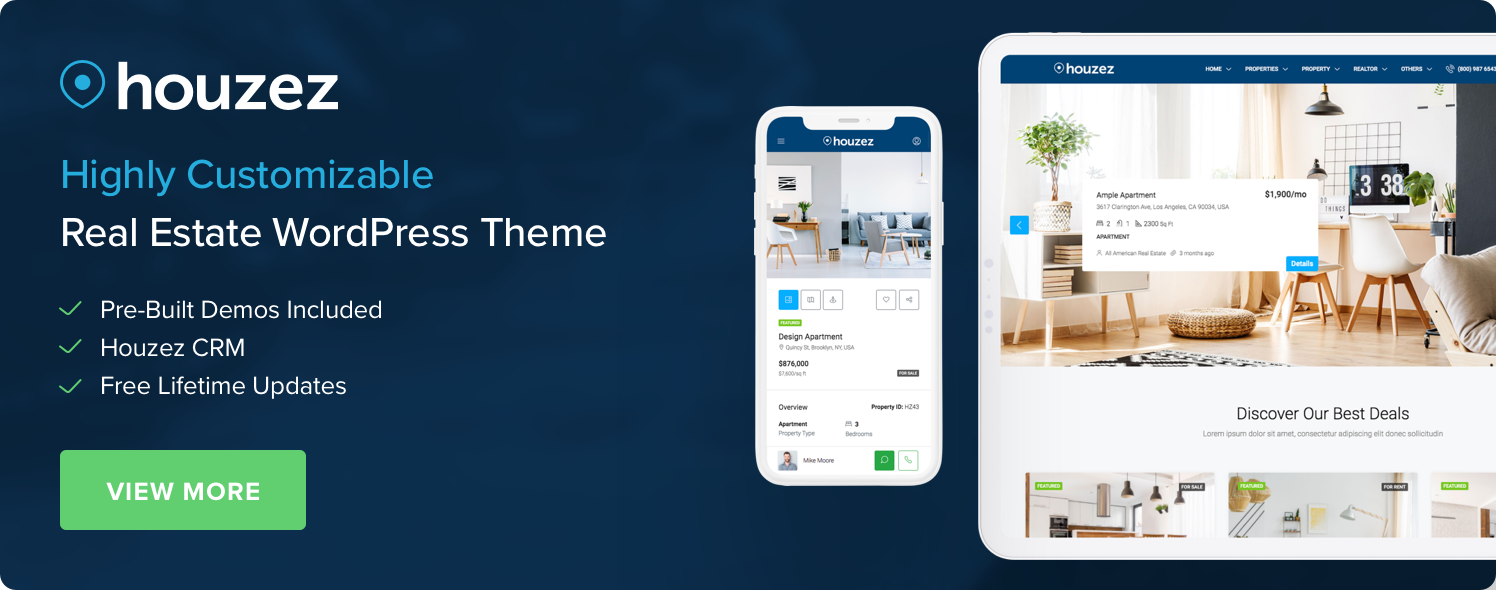
Purpose-built real estate themes like Houzez take a fundamentally different architectural approach: instead of connecting separate tools that were never designed to work together, they ship everything as a single, integrated platform — listings, search, CRM, lead forms, membership, payments, agent profiles, and design customization — all built to communicate natively with each other.
What This Looks Like in Practice
Consider the CRM example. With a plugin stack, your lead capture form (WPForms) has to pass data to a CRM plugin, which ideally syncs with your email tool, which may or may not display inquiry history on the property page. It works — when it works — because you’ve carefully configured the bridges between tools.
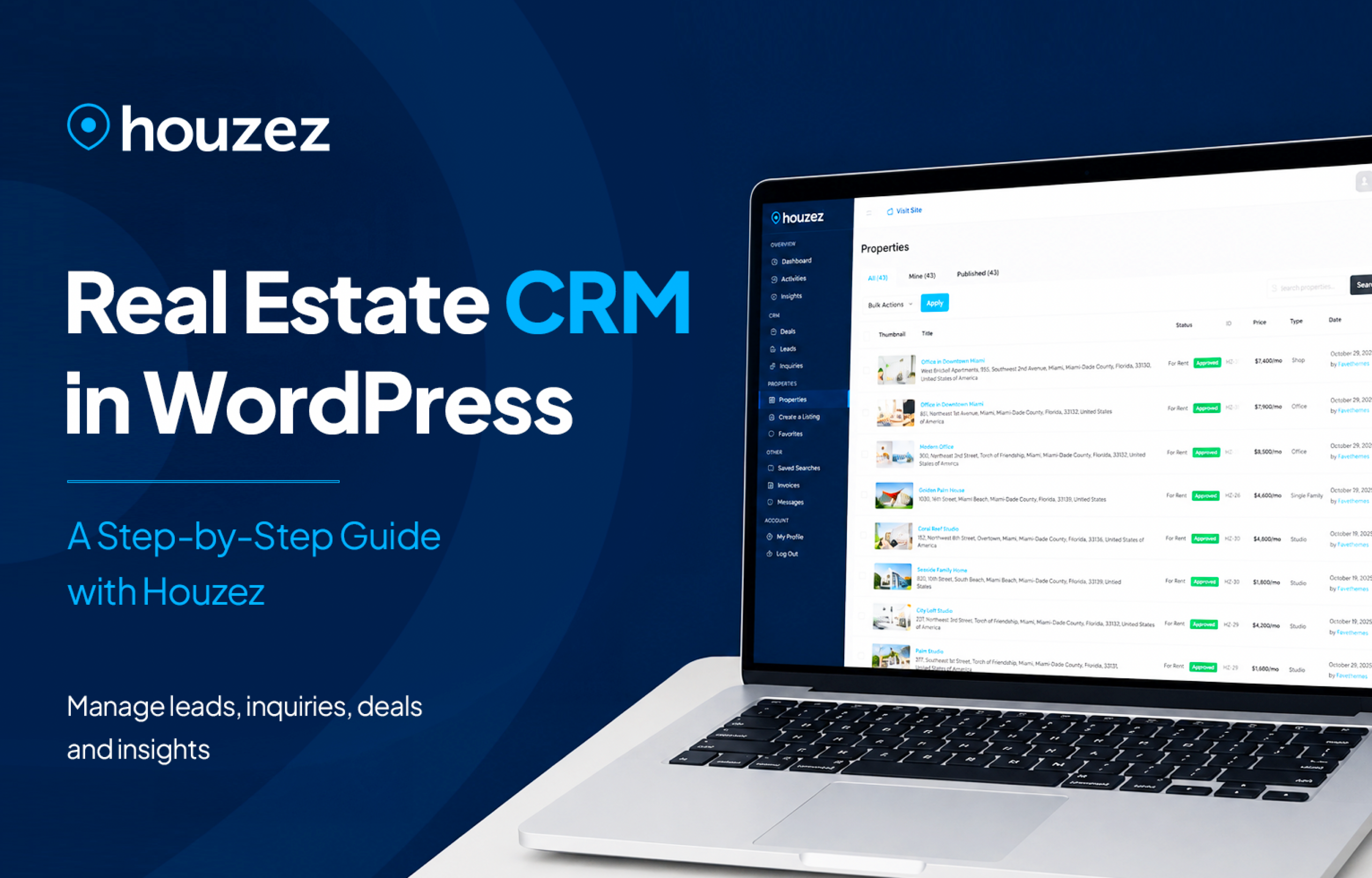
In Houzez, the inquiry form and the CRM are the same system. When a buyer submits an inquiry on a property page, that lead appears immediately in the CRM dashboard — with the property linked, the agent notified, and the full contact history tracked. No configuration. No bridges to break.
The same principle applies to the search system (built-in, visually customizable via Elementor), the membership and payments (activated with a toggle, no WooCommerce add-ons required for basic flows), agent profiles (native post type, not a bolted-on plugin), and 150+ Elementor widgets purpose-built for real estate — not generic content widgets repurposed for property listings.
The Real Cost Comparison
Let’s put the two approaches side by side — not just at purchase, but across a realistic 3-year ownership window, which is closer to the actual lifespan of a client’s real estate site:
| Cost Factor | Plugin Stack Approach | Purpose-Built Theme |
| Initial theme/tools cost | $643–$1,073 | $69–$79 (one-time) |
| Year 2 renewals | $584–$924 | $0 (updates included) |
| Year 3 renewals | $584–$924 | $0 |
| Dev time: initial build | 40–60 hrs | 15–25 hrs |
| Dev time: annual maintenance | 12–36 hrs/yr | 3–8 hrs/yr |
| Emergency support calls | Unpredictable | Single vendor, faster resolution |
| 3-Year Total (licenses only) | $1,811–$2,921 | $69–$79 |
The plugin stack approach doesn’t just cost more money. It costs more of your most valuable asset: time you could spend on revenue-generating work rather than debugging compatibility issues between tools that were never designed to work together.
When Does a Plugin Stack Make Sense?
To be fair: there are scenarios where a plugin stack is the right answer.
- You’re building on an existing site that already has a defined theme and design system, and you need to add real estate functionality to it.
- You need a single highly specialized feature — such as direct MLS database integration — that a general-purpose theme doesn’t support natively.
- The site scope is minimal: a simple agent portfolio with no search, no CRM, no marketplace functionality.
Outside these scenarios — for any real estate site that needs real functionality — a purpose-built platform delivers better results at lower total cost.
The Bottom Line for Developers and Agencies
The plugin stacking habit persists because it feels familiar and flexible. But familiarity isn’t the same as efficiency. When you calculate the full cost — licenses, development hours, maintenance overhead, and emergency fixes — the math points clearly in one direction.
Purpose-built real estate themes are cheaper to buy, faster to deploy, easier to maintain, and more reliable under production conditions. They’re not a compromise — they’re a more professional choice for anyone building real estate websites at scale.
If you’re still piecing together your real estate stack from nine different vendors, the next project is a good opportunity to reconsider the approach.
Ready to simplify your real estate builds?
Houzez ships with 150+ Elementor widgets, a built-in CRM, advanced search, membership system, and agent profiles — all integrated in a single theme used by 56,000+ real estate professionals worldwide.