Choosing a niche is one of the most consequential decisions a freelancer makes — and one of the least data-driven. Most developers pick an industry based on familiarity or the first client who hired them. Few sit down and actually compare niches on the metrics that matter: market size, average project value, repeat business potential, client acquisition cost, and how well tooling supports fast delivery. When you run that comparison, real estate is the best niche for freelancers in 2026. Not by a small margin. By a significant one.
This is not an opinion piece. This article breaks down the numbers behind the real estate web development market, compares them against generic web design, and explains specifically why the economics of this niche reward specialists far more than generalists.
The Real Estate Niche for Freelancers: Starting With Market Size
The U.S. real estate industry counts approximately 2 million active licensees, with around 1.5 million holding active NAR membership, according to data from the National Association of REALTORS®. That figure represents a client pool of a scale that virtually no other vertical offers a solo freelancer. Add to that tens of thousands of real estate agencies, property developers, and portal operators worldwide, and the addressable market for a specialist real estate web developer is enormous.
What makes market size relevant is not just volume, but density. In a concentrated niche, word of mouth works faster. A strong reputation in real estate web development compounds: one satisfied broker refers to another, and another. The same referral dynamics that make real estate agents successful work in your favour as a specialist serving them.
Compare this to a generic web design practice. Every project requires repositioning and every pitch starts from scratch. Every client needs to be educated on your value. In real estate, the niche does the positioning for you.
Real Estate Niche Project Values vs. Generic Web Design
Project values in the real estate niche for freelancers are structurally higher than in general web design, and for a straightforward reason: the client’s ROI is highly legible. A real estate agent who captures two additional leads per month from a better website, and closes one of them, can attribute tens of thousands of dollars in commission to that site. That visibility allows you to price on value, not on hours.
Project value comparison: real estate vs. generic web design
| Project type | Generic web design | Real estate specialist |
| Solo agent website | $500 – $1,500 | $1,500 – $3,500 |
| Agency / brokerage | $1,500 – $4,000 | $3,000 – $8,000 |
| Property portal / marketplace | $5,000 – $15,000+ | $8,000 – $25,000+ |
| Monthly maintenance retainer | $100 – $300/mo | $300 – $1,000+/mo |
The premium is not arbitrary. Real estate clients understand that their website is a lead generation tool, not a cost centre. When you can show a direct line between site performance and commission revenue, you have a client who is motivated to invest and who will pay for expertise. That dynamic does not exist in most other niches at the same scale.
Repeat Business and the Real Estate Freelance Niche Flywheel
The single most underrated advantage of the real estate niche for freelancers is the structure of repeat work. Real estate professionals do not buy a website and disappear. They grow, they hire more agents, they expand to new markets, they launch new listing portals, they want to add CRM functionality, then a membership plan for agents, then multi-language support.
Each of these is a paid project. And because you already know their setup, you execute faster and bill the same rate — or more. The economics of repeat clients in this niche are compounding.
There is also a referral structure unique to real estate. Agents, brokers, and agencies operate in dense local networks. A brokerage that is happy with your work will recommend you to competitors in other markets without hesitation — because geography limits competition between them, but not between you and other freelancers. A single satisfied agency client in Miami does not prevent you from taking a referral in Boston.
The Differentiation Advantage in the Real Estate Niche
Generic web designers are everywhere. According to data from Upwork and the freelance market broadly, the global freelance economy reached $9.91 billion in 2026 and is growing at 18.6% annually — which means competition in undifferentiated web design is intensifying, not easing.
Specialists in the real estate niche for freelancers operate in a different market. Clients searching for a “real estate website developer who knows Houzez, can set up the CRM, and understands how agents use the front-end dashboard” are not comparing dozens of profiles. They are comparing a handful. That scarcity commands a premium and dramatically reduces the cost of client acquisition.
The differentiation also shows up in the quality of conversations. A generalist spends the first hour of every discovery call explaining what is possible. A specialist walks in already knowing the client’s workflow, their lead management challenges, and what a high-converting property listing page needs to do. That expertise is billable and visible from the first interaction.
What the Real Estate Niche Demands From a Freelancer’s Stack
The legitimate challenge in the real estate niche for freelancers is that the technical requirements are more specific than generic web design. A real estate site that a professional client will pay $4,000 to $8,000 for needs to deliver:
- Advanced property search with geo-radius filtering and map integration
- A lead capture system that feeds directly into a CRM
- A front-end agent dashboard so clients manage their own listings
- Membership and payment infrastructure for portals that charge for listing submissions
- Custom fields for property types that vary by market
- Multi-language support for international and multilingual markets
Assembling all of this from separate plugins creates compatibility risk, maintenance overhead, and a site that is difficult to hand off. Freelancers who try to build real estate sites with generic tools spend significantly more time on each project and still deliver a less coherent product.
How Houzez Makes the Real Estate Niche Accessible for Freelancers
The tooling gap between what real estate clients expect and what a freelancer can realistically deliver is what makes purpose-built platforms like Houzez significant. Houzez is a WordPress theme that ships as a complete real estate business platform — not a design template that requires plugins to become functional.
Out of the box, a single Houzez licence at $79 (one-time, no monthly fee) gives a freelancer:
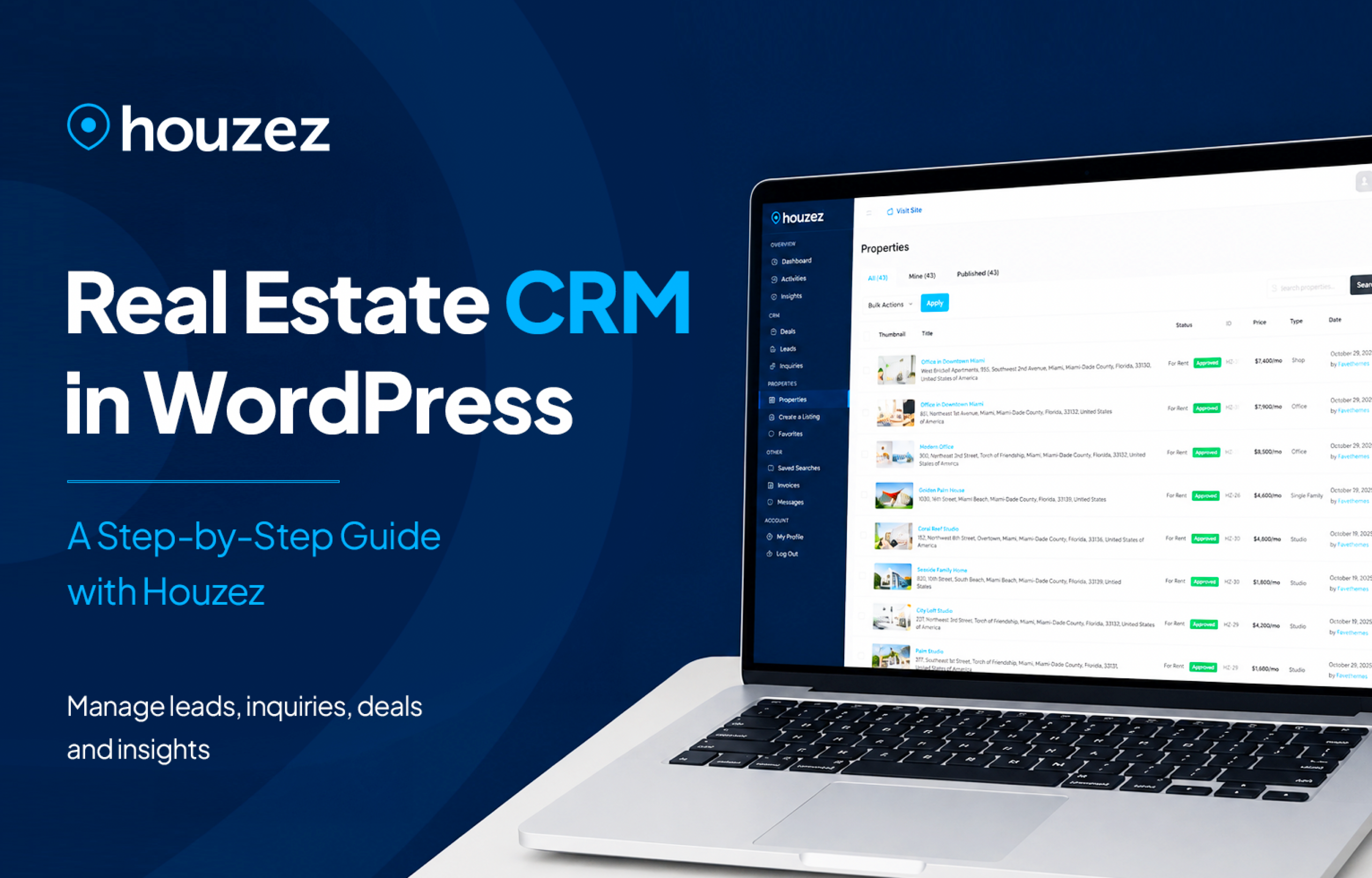
- A native CRM for lead tracking — no third-party subscription required
- 170+ real estate-specific Elementor widgets covering every standard site section
- A front-end dashboard for agents and agencies to self-manage listings
- A built-in membership and payment system for portals with paid submissions
- Advanced search with geolocation, radius filtering, and half-map layout
- 40+ pre-built demos across agent, agency, marketplace, and international market types
- Multi-language and multi-currency support with RTL compatibility
- Free lifetime updates
The practical effect of this is that the build time per project drops significantly. A homepage with property search, featured listings, and agent profiles that would take days to assemble from individual plugins can be structured in hours using Houzez’s pre-built components. That time saving is what converts the niche from theoretically attractive to practically profitable.
For a freelancer delivering three to five real estate websites per month, the difference between using a purpose-built platform and assembling a plugin stack is not marginal. It is the difference between a sustainable business and a constant firefighting exercise. You can explore the full feature set at
The Real Estate Niche for Freelancers: A Numbers Summary
To make the case concrete, consider the annual revenue difference between a generalist and a real estate specialist operating at the same capacity — say, four projects per month:
| Metric | Generalist freelancer | Real estate specialist |
| Avg. project value | $1,200 | $3,500 |
| Projects/month | 4 | 4 |
| Monthly revenue | $4,800 | $14,000 |
| Annual revenue (projects only) | $57,600 | $168,000 |
| Maintenance retainers (avg. 5 active clients) | $1,000/mo | $3,500/mo |
These are conservative estimates. They do not include upsells for CRM configuration, membership setup, SEO services, or lead generation consulting — all of which are natural extensions of a real estate web development engagement and are harder to sell as a generalist.
The Real Estate Niche for Freelancers Is Not a Trend
The freelance market is crowding at the generalist level. According to recent data, the global freelance economy is on track to reach $20 billion by 2030, with competition for undifferentiated work intensifying year on year. The freelancers who will build durable, high-margin businesses in that environment are the ones who specialize early and go deep.
Real estate is not a passing opportunity. It is a permanent market — with 1.5 million active Realtors in the U.S. alone, a global stock of agencies, brokers, developers, and portal operators, and a structural dependence on digital lead generation that is only increasing. The clients are there. The project values are there. The repeat business flywheel is there.
The question is not whether the real estate niche for freelancers is worth pursuing. The data answers that clearly. The question is how quickly you can build the domain expertise and the right tool stack to deliver at the level clients in this niche are willing to pay for.