Most freelancers and agencies lose real estate projects not because their work is weak, but because their proposal is. A vague document with a price and a list of pages signals risk to the client. A structured real estate website proposal — one that names specific deliverables, anticipates questions and shows you understand the industry — signals expertise before the project even starts.
This guide walks you through exactly how to structure a real estate website proposal that converts prospects into paying clients, at the rates you actually want to charge.
Why a Generic Web Proposal Fails in Real Estate
Real estate clients — agents, brokers, agencies, portal builders — are not buying a website. They are buying leads, listings, and in many cases a full business operation that runs through the site: CRM, property submissions, agent management, membership billing.
When your proposal reads “WordPress website, 5 pages, contact form, $X,” you are positioning yourself as a commodity. Every other freelancer on Upwork looks identical at that level of description.
A real estate website proposal that wins is one that demonstrates you already understand what the client needs before they explain it. That means naming the right features — advanced property search, integrated CRM, agent dashboard, membership system — and explaining why each one matters to their business, not just their website.
The Structure of a Winning Real Estate Website Proposal
Before diving into the sections, one thing worth saying clearly: the goal of a proposal is not to document everything you plan to do. It is to make the client feel that you already understand their business, that you have a clear plan, and that hiring you is the lowest-risk decision they can make. Every section below serves that goal.
1. Executive Summary (Half a Page, Maximum)
Open with a short paragraph that reflects the client’s situation back to them. Not what you do — what they need.
Example framing:
“You currently manage property listings manually and respond to inquiries through a generic contact form. The goal of this project is to give you a professional real estate platform that captures and organises leads automatically, lets agents manage their own listings, and is ready to scale.”
This shows you listened. It also sets the frame for everything that follows.
2. Scope of Work — Be Specific, Not Generic
This is where most proposals fall apart. “Design and development of a real estate website” tells the client nothing. Break the scope into functional modules that map directly to what the site will do.
A well-structured scope for a mid-range real estate project typically includes:
- Property listings system How many listing types (residential, commercial, rental)? Will agents submit listings themselves via a front-end dashboard, or will you manage uploads? What custom fields are required (energy class, parking, surface area, floor)?
- Property search Standard filter search, or advanced multi-select with geolocation and radius? Will the client need a half-map layout — the split screen showing a list and an interactive map simultaneously? Specify this. It is a concrete deliverable the client can visualise, and it is one of the features that separates a professional real estate platform from a basic listing page.
- CRM and lead management Will the site capture inquiry leads and organise them inside a dashboard, or will it forward everything to an external inbox? A built-in CRM — one where the client can track inquiries, assign leads to agents and monitor follow-up — is a significant upsell and a concrete value add. Describe it in plain language: “All property inquiry forms feed into a CRM dashboard where your team can track every lead from first contact to closing.”
- Agent and agency management How many agents will use the site? Do they need individual profile pages, their own listing portfolios and access to a front-end dashboard without touching the WordPress backend? Specify who can see what.
- Membership and monetisation (if applicable) If the client wants to charge third-party agents to list properties — through paid submission packages, featured listing upgrades or recurring membership plans — this is a separate module that needs its own line in the proposal. Include the payment gateway (Stripe, PayPal, WooCommerce) and whether the site will support recurring billing.
- Design and branding Number of custom page templates, use of pre-built demo as a starting point, logo and colour integration, responsive and mobile optimisation.
- Technical setup Hosting environment, performance configuration, GDPR compliance setup, multi-language if required.
Breaking scope this way does two things: it prevents scope creep later, and it makes the client feel that you have already thought through their project in detail. Both of those things justify a higher price.
3. What Is Not Included
A short “out of scope” section protects you and sets clear expectations. Common exclusions for real estate projects:
- Content writing for property descriptions
- Photography or virtual tours
- SEO copywriting beyond technical setup
- Custom plugin or third-party API development not specified above
- Ongoing maintenance (offer this as a separate retainer)
4. Timeline
Break the project into phases with realistic delivery windows. For a standard real estate site using a purpose-built theme and pre-built demo as a starting point, a realistic timeline looks like this:
| Phase | Deliverable | Duration |
|---|---|---|
| 1 | Discovery, brief sign-off, demo selection | 2–3 days |
| 2 | Theme import, brand setup, homepage and listings | 4–5 days |
| 3 | Search configuration, CRM setup, agent dashboard | 3–4 days |
| 4 | Membership/payment setup (if applicable) | 2–3 days |
| 5 | Testing, revisions, client training, launch | 3–4 days |
Being specific about phases — rather than just saying “4–6 weeks” — signals that you have done this before and you have a system.
5. Investment
This is where your scope structure pays off. When you have broken the project into named modules, pricing becomes transparent and easier to defend.
Structure your pricing in tiers rather than one number:
- Essential — Listings, standard search, responsive design, contact forms
- Professional — Everything in Essential + advanced search with geolocation, integrated CRM, agent dashboard, front-end submission
- Portal — Everything in Professional + membership system, paid listing packages, Stripe/PayPal billing, recurring plans
Each tier represents a different kind of client — the single agent, the agency, the portal builder. Presenting all three makes the middle option look reasonable, and it shows you understand the market.
One line that helps justify pricing in every tier: the platform you are building on is purpose-built for real estate, not a generic template adapted from a multipurpose theme. A client who has previously been quoted by a generalist who would use a page builder and a property listings plugin understands the difference when you explain it.
6. Why This Approach (And Why You)
A short section — three to five sentences — that explains your methodology. Not a biography. Something like:
“Every real estate project I deliver is built on a platform designed specifically for this industry: a theme with a native CRM, an advanced search builder, and a front-end agent dashboard built in. This means your clients manage their own listings without calling a developer, and every inquiry goes directly into a structured pipeline — not an email inbox.”
This is where the tool you use becomes a direct argument for hiring you over someone else. You are not just building a website. You are delivering a system.
7. Next Steps
End with a clear, low-friction action. Not “let me know if you have questions.” Something specific:
“If this looks right, I can schedule a 30-minute call to confirm scope and answer any questions before I send the contract. Alternatively, if you are ready to proceed, the next step is a 30% deposit to reserve your start date.”
Give them two paths. Both lead forward.
The Tool That Makes Your Proposal Credible
A proposal is only as credible as the deliverables it describes. When you name specific features — half-map search, front-end agent dashboard, integrated CRM, membership tiers, Stripe billing — you need to be able to deliver them without weeks of custom development or a stack of incompatible plugins.
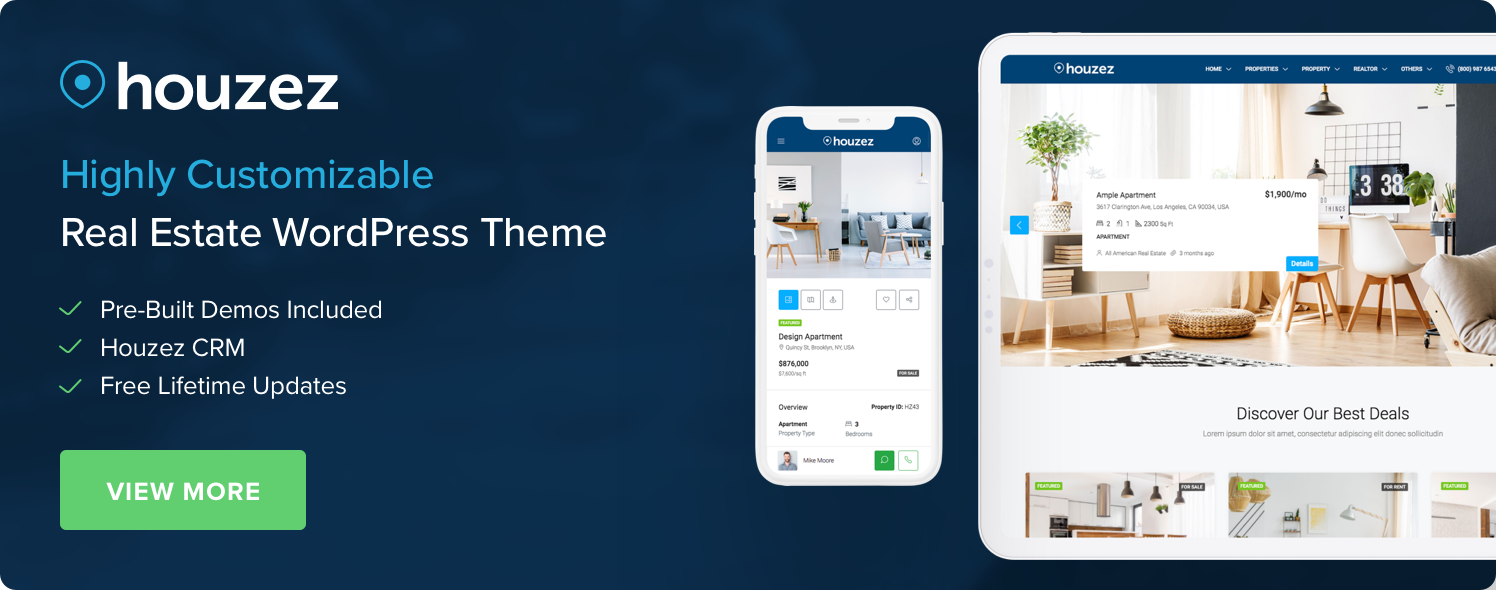
This is the practical argument for building on Houzez: it ships with all of those features in a single theme. The CRM is native. The search builder is visual and produces production-ready results. The membership and payment system supports recurring plans out of the box. The front-end dashboard means agents never touch WordPress admin.
When you write a proposal that promises an integrated real estate platform, and you are building it with a tool that actually works that way, you are not overselling. You are describing exactly what the client will receive.
A Note on Revision and Maintenance
The proposal should not be the end of the conversation — it should be the start of a longer relationship. Real estate websites require ongoing attention: new property types, search filter updates, CRM configuration as the team grows, plugin and theme updates.
A maintenance retainer — even a modest monthly agreement that covers updates, performance checks and minor configuration changes — is a natural add-on once the client sees the platform in action. Build this into your proposal as an optional line item. Most clients who see the system working will want someone to keep it that way.
Your Proposal Is a Sales Document
The best real estate website proposals are not technical specifications. They are sales documents that happen to contain technical information. They show the client what their business looks like after the project is done, and they make it easy to say yes.
Write scope in plain English. Price in tiers. Name the features that matter. Explain why your approach is different. And build on tools that let you deliver exactly what you promised.
If you are not sure where to start, houzez.co gives you a clear picture of what a purpose-built real estate platform looks like — and what you can credibly put in your next proposal.